
Fleet Management Benefits: Why Control Emerges from the System

Find out how complex vehicle fleets are digitized, which strategies the major players use to optimize their mobility processes, and what value a paradigm shift in fleet management can create for your organization.
In this article, you will learn about:
- The most important benefits of modern fleet management >
- Why fleet management today is more than administration >
- How data integration becomes the foundation for better decisions >
- Why costs, compliance, and processes must be considered together >
- When professional fleet management delivers its greatest value >
- Why software architecture matters more than individual features >
- How management by exception is transforming operational control >
- How comm.fleet provides systemic support for complex fleets >
- FAQ – Frequently asked questions about the benefits of modern fleet management >
Benefits of Modern Fleet Management at a Glance
Modern fleet management creates the foundation for more efficient processes, robust decisions, and better financial control across the entire fleet.
The key benefits at a glance:
| Challenge | Benefit of Modern Fleet Management |
| Scattered data and spreadsheets | A central, consistent data foundation creates transparency and reduces media breaks. |
| High coordination overhead | Processes interlock automatically, reducing manual coordination. |
| Unclear cost structures | TCO and cost drivers become visible across the entire vehicle lifecycle. |
| Growing compliance requirements | Deadlines, evidence, and responsibilities are documented in an audit-proof manner. |
| Increasing complexity | Even large, decentralized fleets remain manageable. |
| Decisions based on gut feeling | Reliable data enables well-founded operational and strategic decisions. |
To realize this added value, we first need to understand what defines modern fleet management today.
Fleet Management: More Than Just Administration
In many organizations, the fleet is still managed primarily in an administrative capacity — often, due to limited capacity, as a side task. The focus inevitably falls on the essentials: keeping vehicles operational, processing invoices, and fulfilling basic vehicle-keeper obligations.
Modern, extended fleet management goes decisively beyond this. It shifts from pure reactivity to active, data-driven control. As we explain in detail in our article on Goals, Tasks, Duties & Processes in Modern Fleet Management >, this approach is not limited to classic administrative routines such as driving license checks, procurement, or damage recording.
Extended fleet management integrates deeper, strategic areas of action into the central administrative process, including:
- Cost management & controlling
- Optimizing vehicle utilization
- Pool vehicle management
- Route planning
- Developing policies
- Managing short-term rentals, subscriptions, and other usage models
- Driver communication
- Managing additional asset types
- Strategy development
- Charging planning
- And much more
However, the key difference between reactive fleet administration and strategic fleet management is not simply the greater number of areas covered. Rather, it comes down to a paradigm shift.
 The central insight is that corporate mobility is more than the sum of its parts. Rather than viewing isolated functional areas, holistic fleet management looks at integrated processes and assets with their relationships and interdependencies.
The benefit of this fleet management approach: higher data quality with less manual maintenance effort, transparent Total Cost of Ownership (TCO) analysis, audit-proof compliance processes, fewer media breaks, faster decisions, and greater operational control. Professional fleet management software creates this value not merely by digitizing individual tasks, but by linking data, responsibilities, and downstream processes.
The Value Starts with Connected Data
Many companies only become active in fleet management once a concrete problem becomes visible: when spreadsheets become unmanageable and data records drift apart. When deadlines are missed because they have to be maintained in multiple places. When reports lack substance or require enormous manual effort to produce. When different locations work with different processes and standards are no longer upheld.
These problems are typical symptoms of an IT architecture built on separate data silos. Odometer readings are recorded multiple times: in telematics, workshop invoices, leasing documents, and manual driver reports — often without being reconciled. Fuel data comes from the fuel card provider. Repair information sits with the workshop. Invoices are passed on to accounting for further processing.
Each source may well be correct in isolation. But the fleet only becomes truly manageable once this information is put into relation with one another. This is precisely where comm.fleet fleet management software > comes in: designed as a modular enterprise platform, it can selectively extend existing systems or bring data and processes together within a shared system architecture.
| Individual Features | Systemic Benefit in Fleet Management |
| Digital vehicle file | Technical, commercial, and regulatory information is brought together in a central, historized data foundation. |
| Deadline overview | Deadlines, responsibilities, evidence, and escalations become auditable and controllable. |
| Cost list | Costs are linked to usage, mileage, damage history, contracts, and organizational structures. |
| Reporting | Decisions are based on validated data instead of manually consolidated spreadsheets. |
| Mobile reporting | Events trigger automated downstream processes for the workshop, claims management, documentation, and controlling. |
Do these challenges sound familiar from your own fleet? When vehicle data, costs, workshop processes, and contracts sit in different systems, media breaks and unnecessary coordination effort are often the result.
Let's talk, with no obligation, about your existing system landscape and explore how we can help. >
From Integrated Data to Better Decisions
When information is linked across systems, operational decisions can be made on a far more reliable data foundation. A single odometer reading can influence maintenance needs, lease valuation, tire inspections, billing, or damage assessments.
Practical example: According to fuel card data, a vehicle is reported at 38,500 km. The leasing company, however, has 36,800 km on record, while telematics has already transmitted 39,100 km. Without an integrated data foundation, such discrepancies frequently go unnoticed. Modern fleet management automatically detects these inconsistencies, triggers review processes, and thereby prevents incorrect maintenance decisions or inaccurate lease billing.
Integrated fleet management checks data not just for completeness, but for plausibility. If odometer readings from telematics, the workshop, and driver reports don't match, the discrepancy becomes visible. If an invoice deviates significantly from the usual pattern, it can be flagged for review. If damage claims accumulate at a particular location, the cause can be investigated.
This changes the way of working. Fleet managers no longer need to manually gather every piece of information. Instead, they increasingly work with anomalies, exceptions, and deviations. This marks the shift from data administration to active control.
Cost Control: Fleet Costs Never Arise in Just One Place
A fleet incurs costs across the entire lifecycle of a vehicle or asset. Procurement, leasing, financing, insurance, fuel, electricity, tires, maintenance, repairs, damage, downtime, administration, and remarketing all interact with one another.
Anyone who looks at these cost items in isolation only sees fragments of the picture. A vehicle with a favorable lease rate can become expensive over its term if repairs, tire wear, consumption, or downtime are above average. Conversely, a higher purchase price can make economic sense if availability, residual value, energy consumption, and maintenance costs are more stable.
The added value of modern fleet management lies in taking a lifecycle view. Costs are not assessed in isolation but linked to usage, mileage, technical events, and contracts. This creates a more reliable foundation for procurement, replacement, damage prevention, and remarketing.
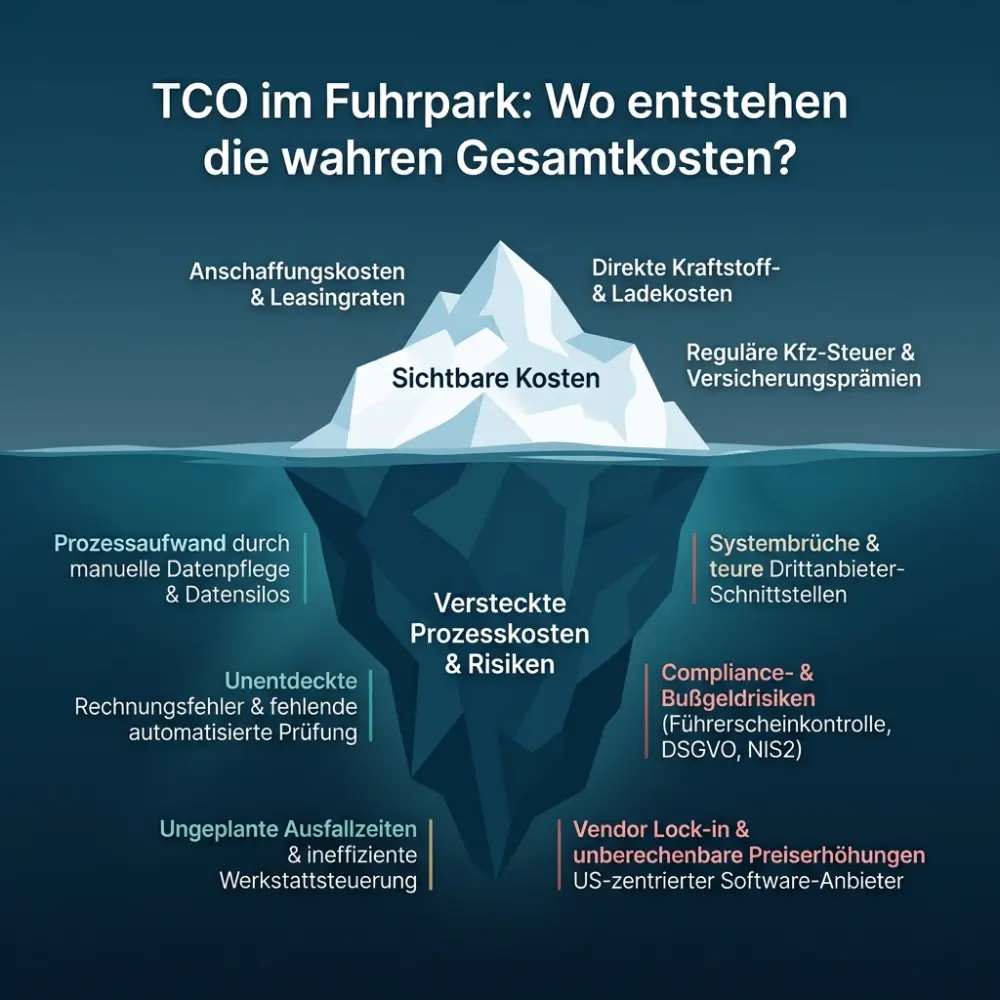 The real economic lever lies not in individual savings, but in the ability to bring together all cost-relevant information along the vehicle lifecycle. Only this creates a solid foundation for investment decisions, procurement strategies, and the long-term optimization of Total Cost of Ownership (TCO).
For CFOs, fleet managers, and procurement departments, this reveals not only which vehicles are driving costs, but — more importantly — why those costs arise, which factors are behind them, and where sustainable value potential can be realized.
You can learn more on this topic in our article on TCO Analysis in Fleet Management. >
Compliance and Vehicle Keeper Liability: Deadlines Alone Aren't Enough
Fleet management is always also a matter of organizational responsibility. Vehicles must be inspected, drivers instructed, evidence documented, and legal or internal requirements complied with.
With regard to vehicle operational safety, Germany's DGUV (German Social Accident Insurance) refers to recurring inspections under Section 57 of DGUV Regulations 70 and 71, along with more detailed inspection intervals and requirements set out in DGUV Principle 314-003 >. The periodic roadworthiness inspection (Hauptuntersuchung) is additionally governed by Section 29 of the StVZO > (Germany's Road Traffic Licensing Regulations).
In small organizations, deadline management can still work on a largely person-dependent basis. In larger organizations, this logic becomes risky. When evidence is scattered across emails, folders, or individual lists, audit readiness becomes difficult to achieve.
Professional fleet management must therefore do more than remind people of deadlines. It must map deadlines, responsibilities, evidence, escalations, and documentation status in a traceable way. The advantage lies in audit readiness: not only is the task itself known, but also its status, history, and assignment.
Benefits in Fleet Management Come from Mastered Complexity
The greatest benefits of holistic fleet management, as described here, compared with simple fleet administration do not automatically emerge once a fleet reaches a certain number of vehicles. What matters is the complexity of the organization.
A fleet of 150 units can be more demanding to manage than a fleet of 500 vehicles if multiple locations, different vehicle types, in-house workshop processes, international requirements, various leasing models, or extensive documentation obligations all come together.
Complexity arises, for example, from mixed fleets of cars, vans, commercial vehicles, and special-purpose vehicles; from decentralized locations, numerous service providers, multiple legal entities, international rollouts, in-house workshops, or additional assets such as trailers, containers, machinery, and auxiliary units.
In such structures, classic standalone solutions often fall short. They capture individual tasks but fail to reflect the reality of the organization. The value of fleet management then lies in the ability to accurately map operational reality within the system.
Benefits of Fleet Management Software: Features Are Just the Beginning
The value of fleet management software is often described in terms of features: digital vehicle files, deadline management, cost overviews, reporting, document management, driver communication, or damage reporting. These features are important, but they say little about how robust and viable a system actually is.
A digital vehicle file is only valuable if technical, commercial, and regulatory information converges within it. The same applies to reporting: it only becomes reliable through consistent data in the background. And a mobile application, too, only delivers real value once a report actually triggers a clearly defined downstream process.
This is why the modularity of comm.fleet > is strategically important. Companies can start with the components they need and add further functionality as requirements, markets, or organizational goals evolve.
When damage is reported via mobile device, that information shouldn't end up as an isolated photo record. It must be capable of being linked to the vehicle file, cost center, workshop process, insurance, repair order, and analysis. When an odometer reading is captured, it must be clear whether it triggers maintenance needs, a lease valuation, a tire inspection, or billing.
Less Manual Coordination Between Fleet, Workshop, Controlling, and IT
Fleet management touches multiple departments at the same time. Fleet management, procurement, the workshop, accounting, controlling, drivers, data protection, IT, legal, and external service providers often work on the same processes — but not within the same system.
A repair case begins with a driver report, moves through the workshop, generates costs, affects the vehicle file, may be relevant for insurance, and later needs to be assessed in controlling. If this process chain is not connected, the result is follow-up queries, media breaks, and manual rework.
Integrated fleet management reduces exactly these breaks — not so people can work less carefully, but so the state of each process becomes visible. Who is responsible, what information is missing, which step has been triggered, and which downstream effect is involved no longer has to be reconstructed from scratch every time.
For mobile process elements, comm.mobile > can be integrated as a web and mobile portal. This gives drivers, employees, partners, or service providers location- and time-independent access to authorized workflows and data.
Many off-the-shelf solutions represent a compromise today. Does your software accurately reflect your fleet's individual processes and interdependencies?
Management by Exception: Focus on Anomalies, Not Data Overload
Complex fleets generate data every day: refueling, charging events, odometer readings, workshop orders, damage claims, invoices, telematics data, contracts, deadlines, and documents. The value lies not simply in making this volume of data fully visible, but in the ability to make deviations recognizable.
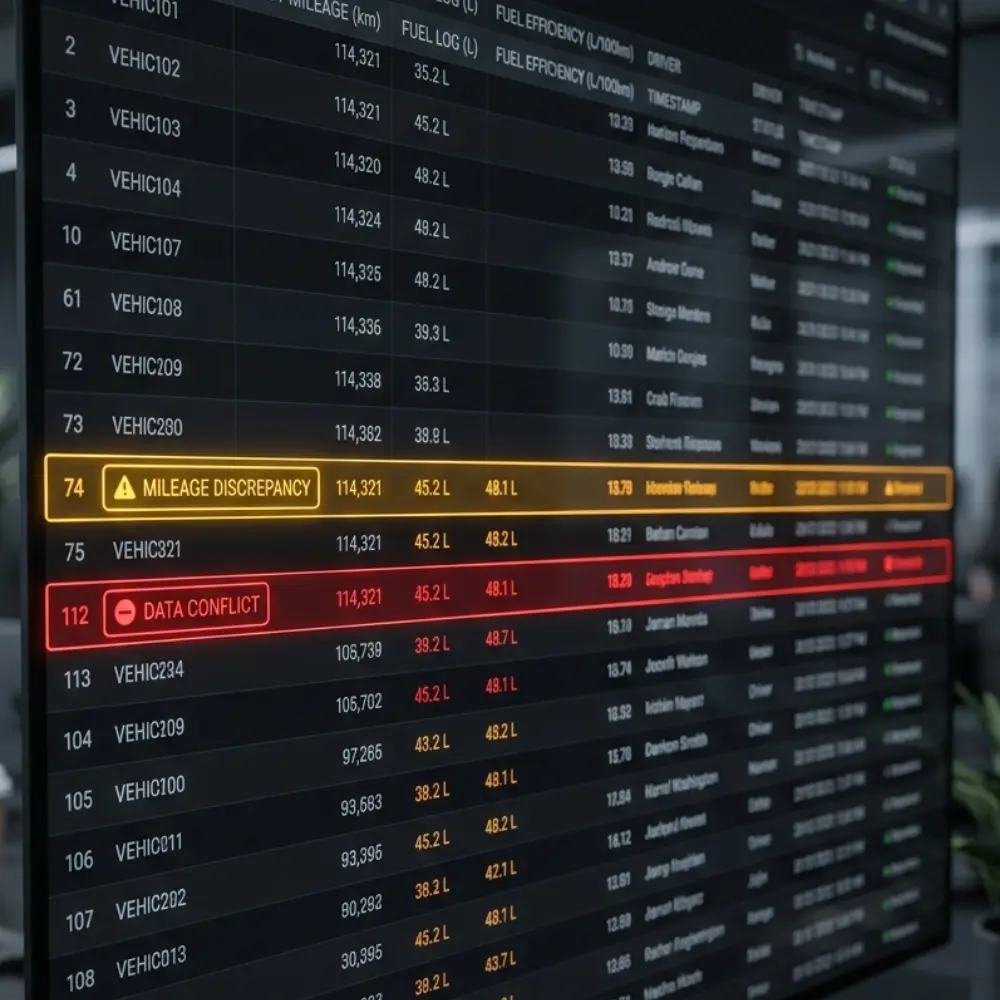 Management by exception means the system directs attention to whatever falls outside expected patterns — for example, when a consumption value doesn't match mileage, a workshop invoice deviates from the usual cost pattern, or an odometer reading contradicts other data sources. A deadline that is approaching without the corresponding process having been started also falls into this category.
Practical example: Instead of manually reviewing hundreds of invoices, the fleet manager automatically receives an alert, for instance, when a vehicle's maintenance costs suddenly rise well above the fleet average, or when fuel consumption increases unusually within a short period. Attention is thereby directed specifically at deviations rather than routine transactions.
Such patterns are difficult to detect manually when information is scattered. Within an integrated system landscape, they become manageable. The fleet then no longer operates purely in hindsight but can intervene earlier.
Bringing Telematics, Real-Time Data, and Data Protection Together
Telematics can create enormous benefits for fleets: better dispatching, greater transparency over vehicle condition, optimized utilization, and earlier warnings of technical anomalies. With comm.gps >, vehicles and assets can be located, telematics data analyzed, and process data integrated with comm.fleet, comm.lease, or comm.object.
The economic value here is created not by individual telematics data points but by their integration into existing business processes. Only when position, usage, and condition data are linked with cost information, workshop processes, contract data, and compliance requirements does a comprehensive control model for the fleet emerge.
At the same time, fleet data is not something to be handled loosely. Location data can constitute personal data. Article 4 of the GDPR > explicitly names location data in the context of identifiable individuals. Article 5 of the GDPR > requires, among other things, lawfulness, transparency, purpose limitation, data minimization, accuracy, integrity, and confidentiality.
For companies, this means fleet management is also a question of IT architecture. Relevant points to check include data storage, hosting model, rights management, role logic, multi-tenancy capability, interfaces, logging, and deletion concepts. The EU explains on Your Europe > that the GDPR sets out detailed requirements for the collection, storage, and management of personal data.
How comm.fleet Makes the Benefits of Fleet Management Usable at a Systemic Level
comm.fleet > is not designed as a standalone administrative tool, but as an integrable enterprise platform for fleet and asset management. The goal is to bring together scattered data sources, processes, and responsibilities within a consistent system architecture. This allows operational, technical, commercial, and regulatory processes to be orchestrated within a shared environment.
The platform supports classic fleet processes such as master data, digital vehicle files, cost management, workshop and inventory management, tire management, damage and accident processes, contract and lease management, fuel, charging, and consumption data, as well as telematics and position data.
The difference doesn't lie in any single feature. It lies in the depth of the mapping. When fleet data, responsibilities, and downstream processes are brought together, the result is fewer system breaks, less manual follow-up, and greater control capability.
For additional asset classes, comm.object > is relevant. Many fleets consist of more than just vehicles. In logistics, industry, the public sector, or technical organizations, trailers, containers, swap bodies, machinery, auxiliary units, tools, or special equipment are all part of everyday operational reality.
How this approach proves itself in practice is illustrated by the project at agricultural cooperative AGRAVIS. The goal was to map cross-location fleet management on a shared data foundation.
Starting Situation
- Around 1,200 company vehicles
- Multiple locations and legal entities
- Different processes and data sources
Challenge
- Heterogeneous system landscape
- High manual coordination effort
- Difficult consolidation of reporting data
Solution
- Implementation of a central fleet platform
- Integration of relevant data and processes
Result
- Unified data foundation
- Transparent, cross-location reporting
- Less manual administrative effort
Read the use case to learn how AGRAVIS restructured its fleet reporting. >
When the Benefits of Fleet Management Become Especially Clear
Professional fleet management pays off especially when an organization regularly runs up against structural limits. Typical warning signs include:
- Data has to be manually consolidated from multiple systems.
- Reports require a high level of coordination effort to produce.
- Deadlines are tracked in separate lists.
- Workshop, tire, or damage processes are not cleanly connected.
- Costs cannot be clearly attributed to vehicles, locations, or usage profiles.
- Telematics, fuel card, leasing, and accounting data remain disconnected.
- Multiple legal entities or locations operate with different workflows.
- Data protection, IT security, or compliance carry more weight in tenders.
- Existing systems are reaching their functional or architectural limits.
In these situations, it is no longer about convenience features — it is about structural control capability.
Conclusion: The Benefits of Fleet Management Come from Architecture
The benefits of fleet management cannot be reduced to time savings, digital tidiness, or better overviews. These effects matter, but they remain superficial.
The real value emerges where vehicles, assets, contracts, costs, deadlines, workshop processes, telematics data, damage claims, tires, users, and service providers are connected within a shared system logic.
For simple fleets, lean administrative software may be sufficient. For complex organizations, fleet management becomes a question of architecture. Anyone looking to further develop their fleet processes should therefore not start with a feature list, but with an analysis of the existing system landscape: Where does which data originate? Which processes depend on one another? How are responsibilities distributed? What risks arise from media breaks? Which decisions need a better data foundation?
Only once these questions have been answered does it become clear what added value fleet management can genuinely create within a given organization.
Anyone responsible today for a fleet spanning multiple locations, different vehicle types, or complex compliance requirements needs far more than a digital vehicle file. What matters is a system architecture that intelligently connects data, processes, and responsibilities. Only then do the real benefits of modern fleet management emerge — better decisions, lower total costs, and a mobility organization that remains permanently manageable.
The development of professional fleets typically progresses through several maturity levels — from isolated standalone solutions to fully integrated, data-driven control.
| Maturity Level | Typical Way of Working |
| Level 1 | Spreadsheets and individual files |
| Level 2 | Multiple specialized tools |
| Level 3 | Connected processes |
| Level 4 | Integrated platform |
| Level 5 | Management by exception |
Every fleet has its own maturity level — and its own potential for development. We're happy to work with you to analyze where your organization stands today and which measures will create the greatest value.