
Tire Management in Fleet Operations: Why TCO Control Starts on the Road

From the perspective of a fleet or tire manager, there is a constant flow of costs and risks between the vehicle and the road that cannot be adequately managed simply by purchasing the right tires, performing seasonal tire changes, or conducting condition checks at the repair shop.
Today, active tire management encompasses the entire tire lifecycle and the associated fleet processes: from procurement through use, inspection, and storage to the phasing out and recycling of tires.
We address the question of how tire condition can be recorded and evaluated, and how these insights can be translated into decisions. We also explain why the legal minimum tread depth is often insufficient, how physical effects impact your bottom line, and why true digital tire management today functions as part of an integrated system landscape.
In this article, you will read about:
- Legal requirements in tire management and why they are insufficient as a guide ›
- The impact of tire management on fleet operating costs ›
- Selecting the right tire ›
- The consequences of incorrect tire selection ›
- Seasonal tire changes ›
- Managing the tire lifecycle ›
- comm.fleet as an example of integrated tire management systems ›
- FAQ – Frequently asked questions about tire management in the fleet ›
Legal Requirements in Tire Management: Why Compliance Alone Is Not Enough
Every journey in a fleet begins with compliance. An experienced tire manager knows that the legally mandated requirements represent the absolute minimum standard. In Germany, this baseline is established in Section 36 of the StVZO: The legally mandated minimum tread depth is 1.6 mm. Falling below this limit not only risks fines; insurance coverage is also at stake.
Conversely, however, it does not automatically follow that tires with 1.7 mm or 1.8 mm of remaining tread depth are still truly safe. In physical reality, wet traction, braking performance, and driving stability change noticeably even above the legal limit. The ability to disperse water decreases particularly sharply at low tread depths. This simultaneously increases the risk of hydroplaning.
The following therefore applies to tire management in a fleet:
- Vehicles must not be driven on a permanent basis with worn-out or otherwise unsuitable tires, but
- True safety does not result from mere compliance with legal limits, but from early, system-supported management.
Instead, a professional tire manager relies on preventive thresholds that are monitored by the system. The ADAC, for example, recommends a tread depth of about 3 mm for summer tires and 4 mm for winter tires. › This difference is not a conservative safety margin, but an economically sound decision designed to avoid breakdowns, liability claims, and associated costs.
Legal Basis
The following regulations in particular apply to operational tire management in vehicle fleets in Germany:
- § 36 StVZO – Requirements for tires and tread depth ›
- § 2, Paragraph 3a StVO – Situational Requirement for Winter Tires ›
How Tire Management Affects Ongoing Operating Costs in a Fleet
Tire costs in a fleet do not arise sporadically, but rather continuously during operation. Factors such as tire pressure, load, and driving profile constantly affect wear and energy consumption.
To ensure that a vehicle can be operated safely and efficiently over its entire service life, regular inspections form the foundation of any professional fleet tire management program. A classic example is tire pressure. The corresponding recommended values are usually indicated on the door frame or fuel door and form the basis for regular checks in fleet tire management. In day-to-day operations, however, these checks are often neglected. This is problematic for cost-effectiveness: Too low tire pressure increases rolling resistance and thus directly increases fuel consumption.
Added to this is a physical effect that is often underestimated in everyday use—the so-called flexing motion. Excessive deformation of the tire generates frictional heat, which causes lasting damage to the material. The result is gradual embrittlement, which in extreme cases can lead to tread separation. This creates significant risks and avoidable costs, particularly in the commercial vehicle sector.
The main issue lies not only in the physical effect itself, but also in the fact that these effects are not systematically visible in many fleet structures. This leads to a gradual increase in costs.
We would be happy to show you, in a personalized presentation ›, how you can not only document tire data in a legally compliant manner but also use it automatically for TCO management with the help of our software.
Criteria for Selecting the Right Tires for a Fleet
In professional tire management, it is not enough to select tires based solely on purchase price or manufacturer preference. Rather, the key is to choose the right tire for the specific operating scenario or usage profile.
In fleet management in particular, it is often underestimated that a supposedly inexpensive tire can quickly result in higher overall costs under real-world operating conditions than a brand that is initially more expensive.
To select the most suitable tire, fleet managers must systematically evaluate the following criteria in particular:
- actual usage profile of the vehicles (city traffic, long-distance travel, construction site operations, or mixed operations)
- average load and axle loads
- annual mileage of the vehicles
- proportion of driving on highways or inner-city routes
- seasonal operating conditions and strategies for summer and winter tires
- requirements for wet grip, braking distance, and driving stability
- Rolling resistance and resulting fuel consumption
- Expected wear behavior under real-world operating conditions
- Compatibility with existing maintenance and replacement intervals
- Availability and deliverability of tire brands
- Total Cost of Ownership over the entire tire lifecycle
- Digital analysis of condition data within tire management
This issue becomes particularly relevant in fleet operations where vehicles are used under widely varying conditions. While mileage and fuel efficiency are the primary concerns in long-haul transport, urban fleets often prioritize braking performance, sidewall stress, and curb contact.
Depending on the application profile, the same tire can be economically viable or permanently unsuitable—regardless of its quality.
The Potential Consequences of Incorrect Tires in a Fleet
In professional fleet management, the issue of incorrect tires does not begin only when legal limits are not met. In practice, it often arises when tires are consistently operated outside their intended service profile. This includes, for example, tire brands unsuitable for high mileage, mismatched load capacities, insufficient wet grip, or the use of summer and winter tires outside their respective weather conditions.
When vehicles are driven for extended periods with unsuitable or worn tires, gradual consequences often become apparent during operation:
- increased fuel consumption due to higher rolling resistance
- above-average tire wear
- unstable handling in wet conditions or at low temperatures
- longer braking distances
- increased risk of hydroplaning
- additional strain on the chassis and axle components
- unplanned tire changes and workshop visits
- increased downtime within the fleet
- higher tire costs in the fleet
- reduced mileage for certain tire brands
- Difficulty in planning seasonal tire management
- Safety risks due to tires in critical condition
Seasonal tire changes are particularly relevant in this context. The rule of thumb “October to Easter” continues to serve as an operational guideline for switching between summer and winter tires in many companies, but it does not replace an actual assessment of weather and operating conditions. While winter tires can wear out faster and increase rolling resistance at high temperatures, summer tires lose significant traction and driving stability at low temperatures.
For companies, this poses not only a safety risk but also a liability issue. If an accident occurs due to unsuitable or worn-out tires, it can result not only in operational downtime but also in issues related to insurance and labor law. For larger fleets in particular, regularly checking tread depth, tire pressure, and the overall condition of tires is therefore an essential organizational task.
Seasonal Tire Changes in Fleet Management: Typical Challenges
In practice, the seasonal switch between summer and winter tires is less of a scheduling issue than a coordination challenge for fleet management.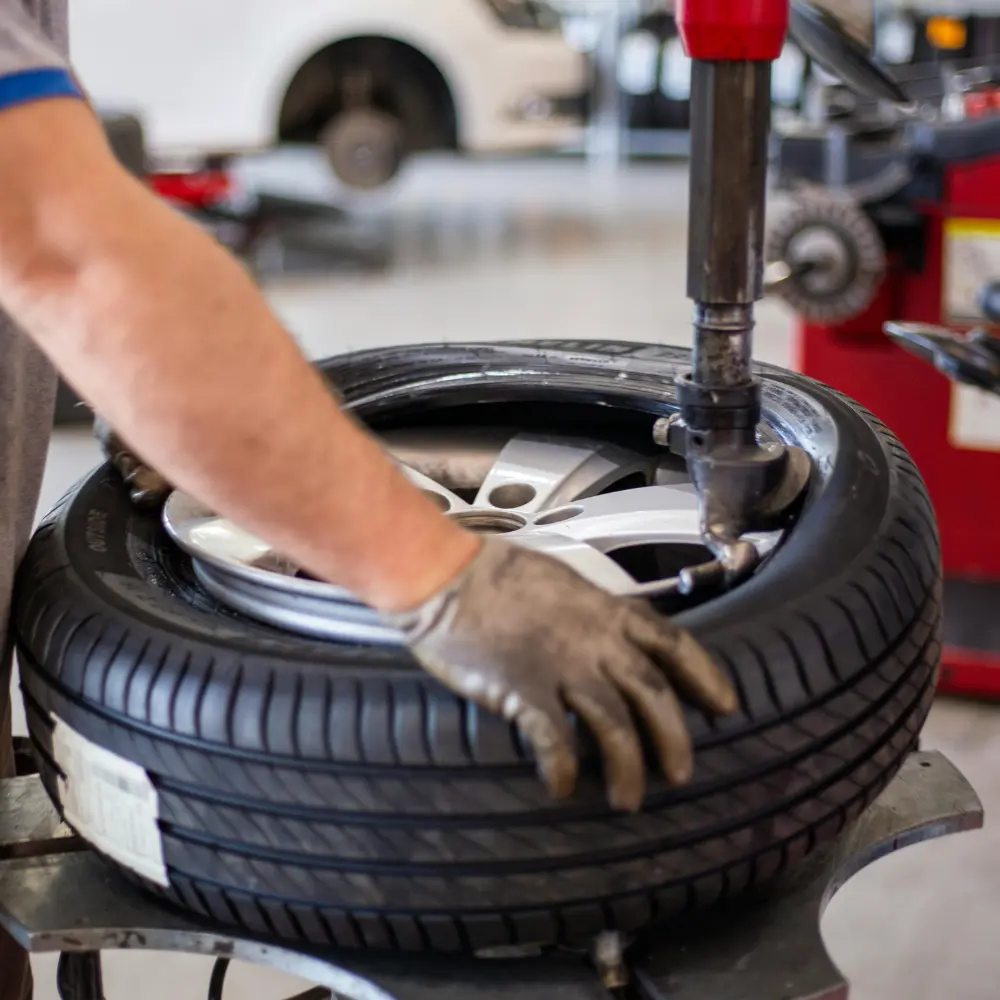 In traditional structures, similar bottlenecks arise time and again: unclear inventory levels, a lack of condition information, or last-minute coordination between the repair shop and scheduling.
Nothing is more inefficient than having vehicles ready for the changeover date, only to find that the right tires are missing or that stored sets are already worn out—a fact that only becomes apparent on-site.
A powerful tire reporting software therefore links condition data such as tread depth or DOT number directly to scheduling. This makes it clear early on which tires need to be replaced. This provides planning certainty, reduces ad-hoc decisions, and plays a key role in reducing tire costs within the fleet.
Data-Driven Management of the Tire Lifecycle in a Fleet
Once a fleet reaches a certain size, tire management can no longer be handled through isolated processes. The number of interdependencies between vehicles, contracts, repair shops, and inventory levels requires a comprehensive system approach.
This is precisely where the concept of tire lifecycle management comes into play. It describes the end-to-end management of all phases of a tire’s life—from procurement through use and storage to recycling. This holistic approach is central to modern fleet tire management. The goal is to manage tires throughout their entire lifecycle using data-driven insights and to optimally balance costs, safety, and availability.
Many providers attempt to address all these issues with individual, isolated solutions. In practice, however, the coexistence of such isolated systems leads to data silos and a lack of transparency.
To map interrelated processes, dependencies, and interactions, a system landscape is needed instead that integrates various data, processes, and sources.
Use Case: How Tire Data Improves Operational Decisions in Fleet Management
A logistics company notices that certain vehicles within the same vehicle class consistently have higher fuel consumption. At the same time, rear-end collisions and unplanned tire changes are becoming more frequent on specific route profiles. Without a consistent data foundation, such trends usually remain isolated observations.
Only the regular collection of condition data—such as tread depth, air pressure, wear pattern, mileage, and tire brand—reveals reliable correlations. Analysis shows, for example, that certain tire models wear out significantly faster on routes with high highway mileage, or that vehicles are driven for extended periods with suboptimal tire pressure or tires unsuitable for the weather conditions.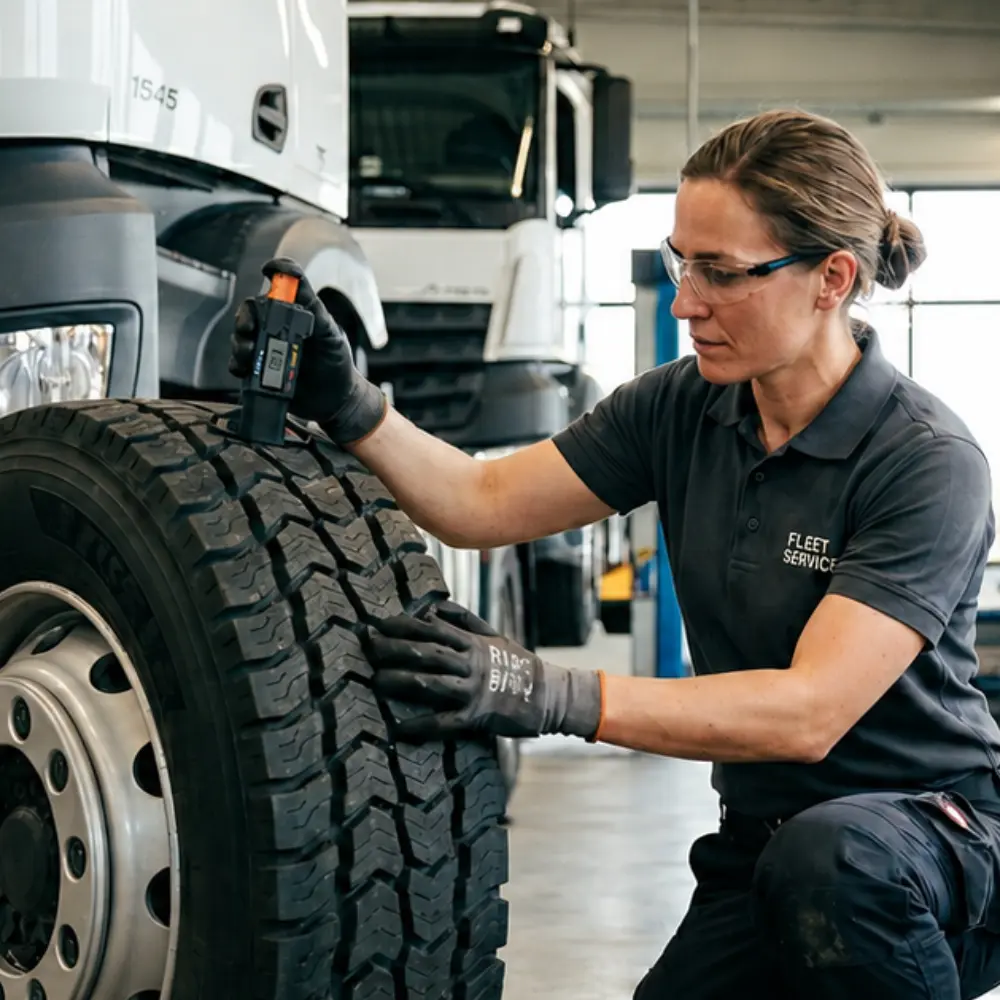 The real added value here does not come from mere documentation, but from the strategic utilization of the data. Companies can evaluate procurement decisions more precisely, tailor tire brands to real-world usage profiles, or classify anomalies more objectively in the event of damage.
Professional tire management not only answers the question of when a tire needs to be replaced—but increasingly also addresses why certain costs, damage, or wear patterns occur in the first place, and develops concrete solutions. This requires the right processes and tools—such as the fleet management software comm.fleet, with its interfaces and integrated tire management.
Integrated Tire Management with comm.fleet
This is where it becomes clear why tire management in a fleet should not be viewed as an add-on. In the comm.fleet fleet management software ›, it is an integral part of a comprehensive ERP system landscape where all relevant data converges.
This integration creates the conditions for not only tracking tire costs in the fleet but also actively managing them. Workshop invoices are automatically reconciled with stored contracts, making discrepancies immediately visible. At the same time, the depth of data enables a precise analysis of which tire brand delivers the best performance under which conditions.
A particularly effective lever lies in intelligent process integration. When companies combine safety inspections and tire changes, workshop visits can be bundled and downtime significantly reduced. comm.fleet automatically identifies such opportunities and supports proactive planning.
In practice, it has been shown that companies can reduce their tire costs by up to 20% and significantly cut down on unplanned downtime by implementing integrated tire management in their fleets. The key factor here is not individual features, but end-to-end system integration.
In this regard, comm.fleet offers not only operational excellence but, thanks to its “Made in Germany” architecture, also the technological sovereignty that is critical to the success of fleets in times of global instability.
Let’s talk about your tire management!
Are you looking for an integrated platform to actively manage tire costs and eliminate process gaps in your fleet? Let’s schedule a one-on-one meeting to discuss the architecture of your fleet infrastructure and see how comm.fleet meets your needs. ›