
Truck fleet management software for complex commercial vehicle fleets

For companies with sophisticated logistics structures, traditional fleet management is no longer sufficient. Today, cost-effectiveness is no longer achieved through the isolated optimization of individual processes, but through the ability to orchestrate vehicles, drivers, workshops, real-time data, cost structures, and regulatory requirements within a unified system framework.
Manufacturer telematics, fuel cards, tachographs, workshop processes, mobile applications, leasing data, driver qualifications, and real-time information generate highly dynamic data environments that can hardly be managed consistently with fragmented individual solutions.
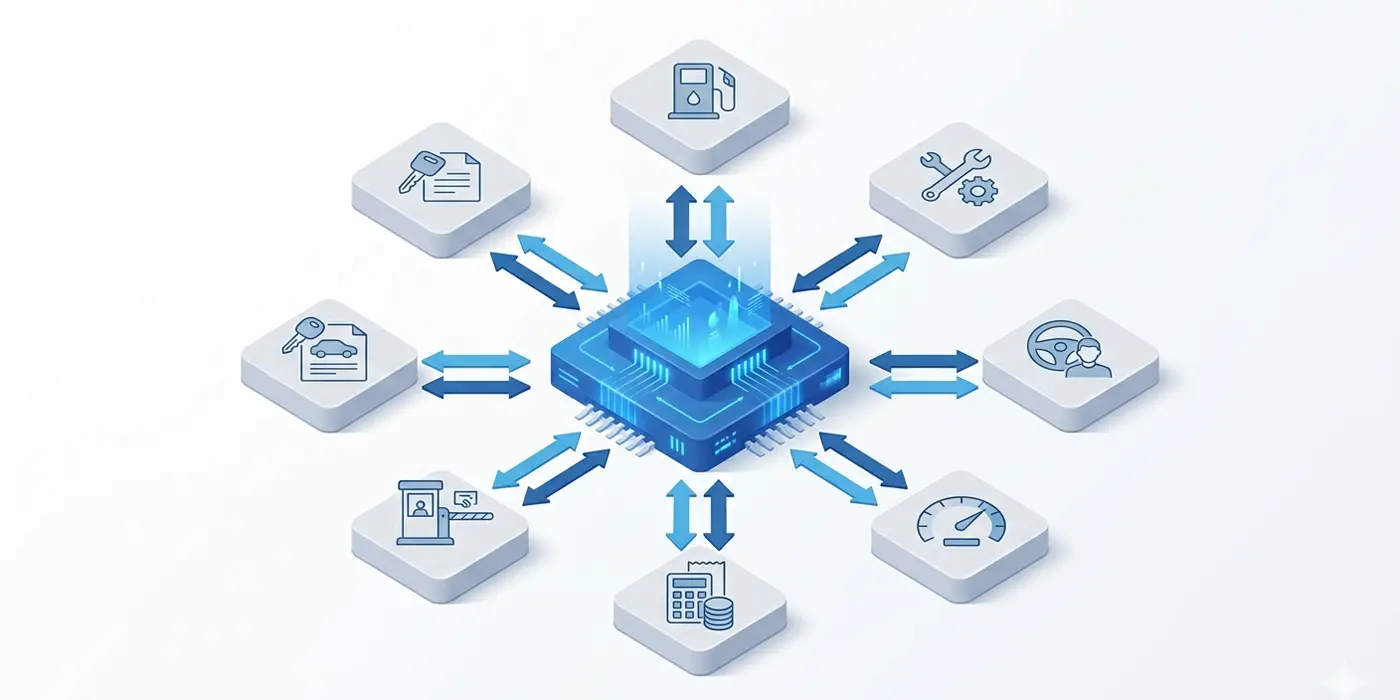
This makes it clear why modern truck fleet management must be strategically reimagined today: Professional fleet managers today do not need supplementary fleet management software, but rather a powerful, robust, and resilient ERP infrastructure that integrates data from different systems. Only in this way can operational relationships be digitally mapped.
In this article, you will learn about:
- Challenges in modern truck fleet management ›
- Truck fleet management as an integrated approach ›
- Key functions in truck fleet management ›
- The complexity of fleet processes as a decisive factor ›
- Criteria for selecting high-performance truck fleet management software ›
- The benefits of suitable fleet management software ›
- comm.fleet and its extensions as an example of an integrated system platform ›
- FAQs on truck fleet management ›
Challenges in Modern Truck Fleet Management
Today, fleet managers are faced with an ever-increasing array of tasks and expectations. › One structural contradiction stands out in particular:
In the day-to-day operations of a fleet, numerous interrelated processes interact with one another. Maintenance cycles directly influence vehicle availability, fuel costs have a direct impact on the operating margin, while inspection deadlines and documentation requirements determine the legal protection of the owner’s liability.
In contrast, operational processes have mostly evolved over time: Individual departments work with separate applications, differing data sets, and responsibilities that are isolated from one another. The problem is rarely a lack of information—but rather a lack of integration.
In complex commercial vehicle fleets, operational transparency rarely fails due to a lack of data—but rather due to fragmented system architectures.
This becomes particularly critical in commercial vehicle fleets that operate multiple brands. Many companies use the manufacturer-provided telematics systems of various vehicle brands because they are cost-effective and provide extensive operational data. At the same time, this creates parallel system environments with different data logics, dashboards, and levels of integration.
What initially appears to be an organizational problem is, in practice, usually a systemic shortcoming of the underlying IT architecture. In many logistics organizations, for example, up to five different odometer readings per vehicle can arise because workshop, telematics, and leasing data differ from one another. As a result, maintenance cycles are incorrectly prioritized, operating costs are miscalculated, and TCO analyses are distorted.
Typical symptoms of fragmented system landscapes
- Inconsistent or redundant data sets with conflicting metrics
- Manual reconciliation processes between scheduling, the workshop, and controlling
- Lack of transparency regarding actual operating costs and TCO structures
- Isolated analysis of individual metrics without systemic context
- Significant effort required for cross-vehicle and trailer-related analyses
- Lack of reliable process-level integration of driver, vehicle, and real-time data
- Missed inspection deadlines (HU, SP, UVV)
Warning! System and data discontinuities can cause significant operational and financial risks—if obligations are neglected, legal consequences may even arise due to owner liability.
Truck Fleet Management as an Integrated Approach
The systematic digitization of fleet management processes offers extensive opportunities and potential—but these do not lie in the mere aggregation of data, but rather in the intelligent integration of different data sources. Only through a consolidated database can operational relationships be reliably identified and managed in a cost-effective manner.
What does this mean in concrete terms? Fuel card statements show costs, while telematics systems provide consumption data. Only the systematic merging of these two data sets enables plausibility checks. This allows irregularities, excessive consumption, misfueling, or technical defects to be quickly identified—and even automated, thanks to intelligent software.
The same applies to the evaluation of complex driver-vehicle combinations in large logistics fleets: If drivers use different vehicles or complex combinations, an integrated database enables the consolidated evaluation of fuel consumption, tire wear, damage, or mileage for bonus/penalty models.
Typical integrations include:
- Telematics data to track usage and vehicle condition
- Tachograph data to ensure compliance with legal requirements
- Fuel card data for cost analysis and validation
- Toll data for cost allocation based on usage
- Financial and leasing data for a comprehensive TCO analysis
- Driver and qualification data
- Workshop and spare parts system
To transform administrative management into data-driven operational fleet management, you need truck fleet management software that seamlessly integrates data, processes, and real-time information.
If you recognize these challenges from your own fleet, it’s worth taking a structured look at your current system landscape. Often, concrete starting points for greater transparency, lower process costs, and improved controllability can already be identified here. Let’s talk about your challenges. ›

Background: An Overview of Mandatory Inspections
Regular inspections are essential to ensure the safety and compliance of your fleet. Here you will find further information on the legal requirements in Germany:
• General Inspection (HU): Current requirements and inspection intervals pursuant to § 29 StVZO ›
• Safety Inspection (SP): Inspection of the braking system, chassis, and steering for heavy commercial vehicles ›
• UVV Inspection: Accident prevention regulations for vehicles in accordance with DGUV Regulation 70 ›
Key Functions in Truck Fleet Management
Digital Vehicle File as an Operational Control Center
The digital vehicle file consolidates all technical, commercial, and regulatory information into a single, centralized history. This creates a robust foundation for lifecycle management, cost assessments, maintenance strategies, and audit readiness.
Especially in complex commercial vehicle fleets, this consolidated view enables, for the first time, a comprehensive assessment of individual vehicles, combinations, or technical components throughout their entire lifecycle.
Workshop Management and Condition-Based Maintenance
Modern workshop management goes far beyond traditional scheduling. Today, maintenance is no longer planned exclusively on a time-based schedule but is increasingly controlled based on condition and usage.
Companies with in-house workshops, in particular, therefore require integrated processes linking workshop management, spare parts and inventory management, mechanic scheduling, and operational dispatch.
By integrating with real-time telematics, technical alerts can be immediately translated into operational follow-up processes—for example, regarding maintenance intervals, tire-related events, or technical anomalies.
In tire management in particular, this enables wear, mileage, and cost trends to be analyzed and managed at an early stage.
Compliance and Regulatory Management
Compliance with legal requirements is no longer a mere administrative side issue, but an integral part of professional fleet management systems.
A robust framework automatically monitors inspection and qualification deadlines, archives documentation in an audit-proof manner, and triggers escalation processes at an early stage. This is particularly relevant for ADR certifications, Z95 qualifications, UVV inspections, or vehicle-specific compliance requirements.
This ensures operational safety and provides audit-proof documentation for inspections.
Mobile Processes and Pre-trip Inspections
Digital pre-trip inspections and mobile condition reports are now among the core operational functions in truck fleet management.
Drivers can document damage directly on their mobile devices, capture photographic evidence, and immediately forward defects to subsequent processes.
This creates seamless workflows between drivers, dispatch, the workshop, and claims management—without media discontinuity and without delays in information transfer.
Cost Control and TCO Analysis
Large volumes of data alone do not equate to the ability to manage them effectively. What matters is the ability to establish a reliable connection between operational, technical, and financial data.
By linking fuel data, telematics values, and workshop information, deviations can be systematically identified.
Notable consumption patterns, unusual cost trends, or inefficient usage patterns become visible—and can be actively managed.
At the same time, integrated systems enable differentiated performance billing for subcontractors and transport companies.
This also allows for the systematic mapping of complex models involving:
- Fixed prices
- Performance-based components
- Ad-hoc billing
- Compensation components
- Usage-based cost models.
Applications: Why Complexity Matters More Than Fleet Size
The demands placed on integrated truck fleet management do not increase linearly with the number of vehicles, but rather with the complexity of the underlying operational structures.
An integrated system architecture is particularly relevant for companies that coordinate multiple locations, manage international requirements, operate their own workshop facilities, or need to manage extensive documentation and billing processes.
Modern truck fleet management must be able to realistically map complex units—such as tractor-trailers, semi-trailers, refrigeration units, containers, tail lifts, onboard forklifts, swap bodies, auxiliary units, or industrial trucks.
Added to this are technical and regulatory considerations such as axle combinations, trailer types, refrigeration technology, loads and lift heights, service life of individual components, and requirements specific to the cargo being transported.
Only the modular management of such units makes it possible to effectively manage complex logistics fleets.

How Companies Can Identify High-Performance Truck Fleet Management Software
Today, companies should no longer evaluate modern truck fleet management software based solely on individual features. What matters most is the ability to systematically map complex operational relationships and make them manageable.
Consolidated Data Architecture
All vehicle-related information—technical, commercial, and regulatory—must be consolidated into a unified data structure. Only then can a robust foundation for analysis and decision-making be established.
Simply aggregating data is no longer sufficient. Modern systems must correlate information from manufacturer telematics, tachographs, fuel cards, workshop processes, driver qualifications, and performance reports.
End-to-End Process Logic
From the first vehicle data record to the vehicle’s retirement, processes must be systematically interconnected. Individual work steps must not remain isolated.
This applies in particular to the integration of:
- Driver scheduling
- Workshop management
- Qualification management
- Deadline management
- Cost controlling
- Mobile processes
- Real-time data from telematics systems
Intelligent Automation
Deadlines, data imports, billing, procurement, and verification processes should not only be automated but also controlled by rules—including escalation logic.
In truck fleet management, this applies, for example, to:
- HU, SP, and UVV deadlines
- Driver qualifications such as ADR or Z95
- Training modules
- Maintenance cycles
- Condition-based service intervals
- Automatic follow-up processes in case of damage or defects
Deep integration of external systems
Telematics, fuel card, tachograph, driver qualification, billing, and toll data must not only be imported but also contextualized.
Especially in large logistics fleets, true added value is only created when millions of movement data points are merged with master, cost, and driver data—without compromising performance in day-to-day operations.
Technological sovereignty
Especially in the context of growing regulatory requirements, the issue of data sovereignty is gaining importance. A European system architecture that can be operated independently of non-European cloud infrastructures creates a high degree of digital resilience and strategic security.
Only when these requirements are met can we truly speak of high-performance software for truck fleet management.
Rethinking Cost-Effectiveness: From Cost Control to Strategic Management of Truck Fleets
The economic evaluation of a truck fleet management system goes beyond traditional ROI considerations.
In addition to direct benefits such as reduced administrative overhead and shorter downtime, strategic advantages emerge:
- higher-quality decision-making based on valid data
- improved compliance and reduced liability risks
- sustainable optimization of cost structures
- increased organizational scalability
- reduced operational friction losses
- better manageability of complex fleet structures
The true added value thus lies in the ability to establish the fleet as a controllable integrated system.
comm.fleet as an integrated system platform
Against this backdrop, the comm.fleet fleet management software › positions itself not as a standalone solution, but as a central platform for truck fleet management.
The approach is based on a consistent ERP logic that brings together operational, technical, and commercial processes within a single architecture.
Centralized system logic
All data converges in a consistent structure and is available across all systems.
This creates a decisive advantage, especially for complex logistics fleets: information from telematics, the workshop, cost management, driver scheduling, or performance billing no longer needs to be manually consolidated.
Deep process integration
Workshop management, cost analysis, driver qualifications, mobile processes, and compliance are seamlessly integrated.
This results in end-to-end processes rather than isolated individual solutions.
Modularity
The system’s functionality can be precisely tailored to the specific organizational structure.
This enables companies to manage both traditional vehicle fleets and complex asset structures—including trailers, power units, and other assets—within a single system architecture.
Scalability and Future-Proofing
The system is designed to grow alongside increasing demands—both technically and organizationally.
Even large volumes of real-time and movement data can be processed efficiently and made systematically usable.
Technological Sovereignty
In light of increasing regulatory requirements, comm.fleet offers maximum technological independence based on the open-EIS platform from community4you.
The architecture ensures controlled data sovereignty and technological self-sufficiency while avoiding dependencies on proprietary non-European cloud providers. For companies with high standards for governance and compliance, this digital resilience creates a decisive strategic competitive advantage.
Mobile Processes: From Documentation to Control
Mobile applications in truck fleet management have long since moved beyond mere documentation.
With the mobile driver apllications in comm.mobile ›, operational processes are controlled directly on mobile devices:
- Defects can be recorded by the driver on the go and automatically trigger repair orders
- Pre-departure inspections trigger inspection processes
- Damage reports initiate follow-up workflows
- Image documentation is archived in an audit-proof manner
- Condition reports are directly incorporated into the vehicle file
This makes the mobile application an integral part of process control—not just a data-entry tool
Real-time data streams: Telematics integration with comm.gps
Efficient truck fleet management is based on facts, not assumptions. While commercial administration sets the framework, the comm.gps telematics software › provides the necessary real-time insights into ongoing operations. The system acts as an intelligent connector that feeds location data and operational statuses directly into your central platform.
comm.gps is hardware-independent: You can seamlessly integrate both existing telematics systems from various manufacturers and location data from external hardware.
By combining geofencing, route tracking, and technical telemetry data into a single interface, the boundaries between the office and the road disappear.
The result is complete transparency, which helps:
- Reduce empty runs
- Manage capacity utilization more precisely
- Detect technical issues early on
- Plan availability realistically
- Make data-driven operational decisions
Scalability beyond trucks: comm.object
A modern logistics operation consists of more than just tractors and trailers. To create a truly seamless system landscape, the proven logic of comm.fleet can be extended to the entire inventory and technical assets via the compatible object- and asset management software comm.object. ›
Whether swap bodies, containers, forklifts, or specialized machinery—all assets can be managed within a central architecture.
This eliminates the need for additional siloed solutions.
Companies retain commercial and technical control over all relevant assets within their logistics fleet.
Let’s talk about your fleet architecture
The demands placed on modern truck fleet management are constantly growing. Especially in complex commercial vehicle fleets, the quality of the system architecture determines whether organizations gain operational transparency or are constantly struggling with increasing complexity.
In a personalized demo, we’ll show you how comm.fleet:
- centrally consolidates various data sources
- intelligently links real-time and operational data
- integrates workshop, driver, and compliance processes
- accurately maps complex asset structures
- sustainably improves operational control